|
Click
here to read the introduction to Bridge7's CyberFair..
The system introduced in this site is in
five-card
majors style: Basic methods will
provide Bridge7 members to play at bridge clubs with their friends and across the Internet with
Bridge7 friends in all over
the world easily..
1 NT opening shows 15-17 points without five cards in major
suits. Weak two-bids
shows 6 cards suit. 2 Clubs opening is strong and artificial. Limit raises,
Stayman, transfers, RKCB, negative doubles, are standard conventions. Jump
overcalls are preemptive in competition. Doubles of opponent's suit openings are
take out through the game...
The Advanced Bridge section contains more
sophisticated bidding and playing methods for improving bridge techiques of
Bridge7 friends..
Good Luck Bridge7 firends..
1.1 Terms
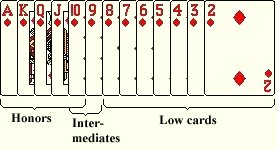
1.1.1 Intermediate Cards= 10 and 9 in any suit
are called intemediate card.
1.1.2 Auction = The bidding phase of bridge.
1.1.3 Balanced hand = A hand without voids and singletons. Distributions 4-3-3-3 or
4-4-3-2 are examples of balanced hands.
1.1.4 Convention = Bid which has a special meaning
1.1.5 Trick = The cards played and won in a single round.
1.1.6 Honor = Any of the five higest cards in a suit: Ace, King Queen, Jack and
Ten. The ten is honor card without point value
1.1.7 Suit = Any of the four sets of thirteen playing cards: spades,
hearts,
diamonds and clubs.
1.1.8 Low card = Cards ranking from eight to two in a suit.
1.2 Point Count
Note: Go to Section 10 for practicing point
count
In the game of bridge, you use points to evaluate your
hand. In order to
make a good contract, you must know the value of your hand. You can evaluate your
hand by combining high card points and distributinal points.
1.2.1 High-Card Points
Use only high card points to evaluate your hand in notrump contracts.
| Honors |
Card |
Point |
| Ace |
 |
4 |
| King |
 |
3 |
| Queen |
 |
2 |
| Jack |
 |
1 |
| Ten |
 |
0 |
1) High-Card points abbreviated as
HCP.
2) Total HCP points in the deck is 40. |
1.2.2 Distributional Points
There are several ways to
count distributional points. Widely used ones are:
1- Long suit points: Added to HCP before
your partnership has reached a fit.
2- Short suit points: Added to HCP after your partnership has reached a
fit.
Long
and short suit points must not be combined (must never be cumulated) in evaluating your
hand.
1.2.2.1 Long Suit Points (Length
Points)
Evaluate your hand with high card points and long
suit points unless you are supporting your partner's suit.
1.2.2.2 Short Suit Points (Dummy Points)
Short suit points are added to high card points
after your partnership found a fit (shortness method).
| Distribution |
Point |
Description |
Example
(click on the example) |
| Void |
5 |
If you have a missing suit
(void) you
have the ability to trump losers. So count 5 points..
|
|
| With
support with partner's suit
|
| Singleton |
3 |
If you have a single card in a
suit, sooner
you will have the ability to trump losers. So count 3 points..
Singleton honors (like
K, Q and J) can not have both HCP and short suit points: If you have
unprotected honors, just add 3 points for short suit points. Not both of
them.
|
| With
support for partner's suit
|
| Doubleton |
1 |
If you have double cards in a
suit, later
you will have the ability to trump losers. So count 1 points..
If your doubleton suit is in the form of:
K Q,
K J, Q J, Q x, J x don't count both honor and distribution points. Because
this kind of hands easily lose to opponents' high cards.
|
| Note: Use above short suit
points to revaluate your hand after you reached a fit. Here is an example
about revaluating:
            
This hand has
8 HCP + 1 long suit (club) point = 9 total points.
If your partner bids 1S, you have four-card support in spades.
In this case, you can revaluate your hand as:
8 HCP + 3 short suit (diamond) point = 11 total points.
|
1.2.4 Total Points
The sum of high card points (HCP) and one of the
distributional points (long suit or short suit point) is called total points
(TP).
When you are opening a bid or bidding a new suit you must evaluate your hand with
HCP & long suit points. So,
TOTAL POINTS= HIGHCARD POINTS +
LONG SUIT POINTS ...... (1.1)
Plese see Chapter 10 for practicing point
count..
Once your partner opens, and if you
are going to raise your partner's suit you must reevaluate your hand with short
suit points. So, in raising partner's suit you must use below equation.
TOTAL POINTS= HIGHCARD POINTS +
SHORT SUIT POINTS ..... (1.2)
Don't forget that, if you are
opener,
and raising the responder's suit you must also use equation (1.2).
-
Never cumulate long suit
(length) and
short suit (dummy) points; use them separately.
-
If you are evaluating your hand
(either
as opener or responder) for a no trump contract don't use total points; use
only high card points.
Here are some examples for point
counts:
Click on the buttons:
1.3 Ranks
The ranks are imoprtant in the auction. The suit ranks
from
highest to lowest are shown below:
Suit
Group |
Suit
Rank |
|
| No suit |
No trump |
Balanced hands are suitable for notrump
contracts. |
Major
suits |
 spade spade
 heart heart |
Majors are higher ranking
suits. In 5-card major always seek for 8-card major fit with your partner as: 4-4, 5-3, 6-2....
|
Minor
suits |
 diamond diamond
 club club |
Minors are lower ranking suits. If
you don't have 8-card major fit with your
partner, you can play in minor suits. |
At the begining of the auction the lowest suit is 1 . After auction started, the nearest suit to the bidded suit
is the cheapest..
Example;
If the latest bid is : 1 ,
2 expensive suit,
1 cheapest suit.
or,
If the bid is :1 ,
3 expensive suit.
2 is cheapest.
1.3.3 Suit Length
Long suit = A, R, 7, 6, 5, 3
Short suit = D, 3
1.3.4 Suit Strength
Strong suit = A, R, D, 10, 8,
Weak suit = D, 10, 8, 5, 4,
1.4 Contract
In the auction you can bid one of the below contracts or call
pass, double, redouble...
A contract at the
1-level, for
example1NT, needs 7 tricks.
A contract at the
2-level, for example 2, needs 8 tricks..
A contract at the
3-level, for example
3NT, needs 9 tricks.
A contract at the
4-level, for example 4, needs 10 tricks.
A contract at the
5-level, for example 5, needs 11 tricks.
A contract at the
6-level, for example 6, needs 12 tricks.
A contract at the
7-level, for example 7, needs 13 tricks.
1.5 Contract Levels
Your aim is to make a contract to play in game
(like 3NT, 4 etc.). You
win at least 100 point if you play in game. If you don't have enough
points for game level, you can bid a contract for part score. If your opponents bid
a contract at a higher level than you, your aim is to prevent them making the
contract. You can practice contract levels at the
Section-10 of this site..
1.5.1 Part Score Contracts
A contract whose trick score is less then 100 is called part score
contract.
| Type |
Contract |
Number of Points in the Combined Partnership |
| Suit part score |
Any suit at the 1, 2 or 3-level |
Needs 18-24 combined total points with
8-card
fit in partnership. |
| Notrump part score |
1NT or 2NT |
Needs 20-24 combined total points without
8-card major
fit in the partnership. Balanced hand contracts. |
1.5.2 Game Contracts
Any contract whose trick score is higher then 100 is called game
contract. Slam and grandslam contracts are also game contracts.
1.6 Scoring and Bridge in Computers
1.6.1 Symbols
Please find below the symbols of the high cards;
| Honor |
English Symbol |
| Ace |
A |
| King |
K |
| Queen |
Q |
| Jack |
J |
| 10 |
10 |
| Double |
x |
| Redouble |
xx |
1) Sometimes letter
"T" is used for ten.
2) Low ranking cards are denoted as (x). Letter x is also used in describing doubled
hands. |
1.6.2 Scoring
The scoring depends on the type of bridge you are playing. There are
three types of bridge:
1. Rubber Bridge: The partnership which wins two games
(with
100 points) wins the rubber. Rubber bridge mainly played in clubs for
money.
2. Chicago Bridge :Also known as Four-Deal Bridge. In this type of bridge,
player who gets the highest score wins the game. Chicago bridge mainly played
among friends.
3- Dublicate Bridge: In this type of bridge, players at the different tables
play the same deals. Dublicate bridge is mainly played in clubs, tournaments
and matches.
The scoring is almost same in all three types of
bridges,
but the bonuses change considerably:
1.6.2.1 Scoring in Rubber Bridge
The partnership which wins two games (with
100 points) wins the rubber. The side which makes 100+ points becomes
vulnerable. The part scores add up to 100 or more points. Only in Rubber
Bridge you
can make a game score by accumulating two or more partials. In Chicago
or Dublicate bridge vulnerabilty of the partners is determined in advance. In
Rubber Bridge the bonuses increase or decrease according to vulnerability.
|
Table 1: Trick Score
You get these scores for each trick.
|
|
Trump
|
Trick Score
|
Doubled
Trick Score
| Redoubled
Trick Score
|
| Spade
| 30 | 60 | 120
|
| Heart
| 30 | 60 | 120
|
| Diamond
| 20 | 40 | 80
|
| Club
| 20 | 40 | 80
|
| Notrump
| first trick 40,
thereafter 30 |
first trick 80,
thereafter 60 |
first trick 160
thereafter 120 |
|
Table 2: Overtrick Score
Any extra trick after your contract is subject to bonus. If your
contract is three spades and if you make 5 spades then you have two extra
trick.
|
|
Vulnerability |
Trick Score
|
Doubled
Trick Score
| Redoubled
Trick Score
|
| Non-vulnerable | 20 in
minors,
30 major or notrumpcontracts | 100 | 200
|
|
Vulnerable | 20 in
minors,
30 major or notrumpcontracts | 200 | 400
|
|
Table 3: Undertrick Score
Defending side scores below points for each undertrick if you
fail to take the tricks you contracted to take. For example, you are two down
if your contract is five diamonds and you can make only
three tricks.
|
|
Contract |
Vulnerability |
First Undertrick Score
|
Subsequent
Undertrick Scores
|
| Normal | Non-vulnerable | 50 | 50
|
| Vulnerable | 100 | 100
|
| Doubled | Non-vulnerable | 100 | 200
**
|
| Vulnerable | 200 | 400
|
| Redoubled | Non-vulnerable | 200 | 400
|
| Vulnerable | 400 | 600
|
** After 3 down, the penalty
for each subsequent undertrick becomes 300.
|
Table 4: Slam Bonuses
Slam or Grand slam contracts are subject to extra bonuses.
|
|
Bonus type
|
Score
|
Slam
(if you bid and make a slam contract) | Non-vulnerable | 500
|
| Vulnerable
| 750
|
Grand Slam
(if you bid and make a gran slam contract) | Non-vulnerable | 1000
|
| Vulnerable
| 1500
|
|
Table 5: Other Bonuses
|
|
Bonus Type |
Description
|
Score
|
| Making a doubled contract | If you succeed in
making a doubled contract you get bonus. | 50
|
| Making a doubled contract | If you succeed in
making a doubled contract you get bonus. | 100
|
| High card bonuses | If
declarer has 4 or more high cards in his hand he gets some bonuses (Don't
forget that 10 is a high card) | 100 points for 4 high cards in
trump suit.
|
| 150 points for 5 high cards in trump
suit.
|
| Four aces in notrump
contracts | In no trump contracts if you have all the
four aces you get a bonus.
| 150
|
| Rubber bonus | The
partnership who wins the rubber (by making two game contracts) is
awarded.
| 500 if the opponents are
vulnerable.
|
| 700 if the opponents are
non-vulnerable.
|
1.6.2.2 Scoring in Chicago
In Chicago type bridge, partners change and a new game starts
after four deals. After one round a new game starts with changed partners.
Vulnerability of each side is determined in advance as:
First deal (South deals): Nobody is vulnerable
Second deal (West deals): East-West is vulnerable
Third deal (North deals): South-North is vulnearble
Fourth deal (East deals): Everbody is vulneable.
Trick scoring is same as in Rubber Bridge. Table1, Table2,
Table3 and Table4 is also valid for Chicago. But, the bonuses in Table5 is
different than Rubber Bridge.
Add 50 points for part score
contracts.
Add 300 points for nonvulnerable game
contracts.
Add 500 points for
vulnerable game contracts.
Example:
Vulnerable four hearts
contract:
Score 4 x 30 = 120
Award = 500
Total
= 620
Please find below scoring table for one round in
Chicago:
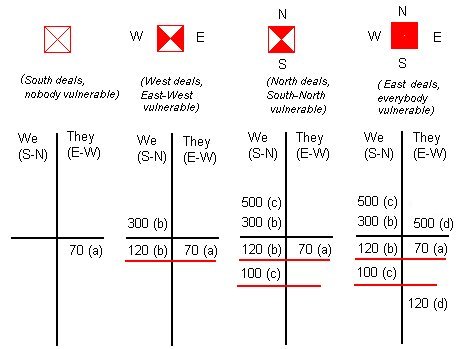
The explanation of scoring table:
(a) They bid 2 NT and made it. Nobody was
vulnerable.
(b) We bid 4 and made it.
They were vulneable.
(c) We bid 3NT and made it. We were vulnerable.
(d) They bid 4 and made
it. Everbody was vulneable.
1.6.2.3 Scoring in Dublicate Bridge
Note: Go to Duplicate Bridge" section for
practicing the scoring
Dublicate bridge is mainly played in clubs, tournaments
and matches. In Dublicate Bridge players at the different tables
play the same deals. Then the results of the tables are compared. In this way
the factor of luck is eliminated.
Trick scoring is same as in Rubber Bridge. Table1, Table2,
Table3 and Table4 is also valid for Chicago. But, the bonuses in Table5 is
different than Rubber Bridge.
Add 300 points for nonvulnerable game
contracts.
Add 500 points for
vulnerable game contracts.
Example:
Non-vulnerable four
spades contract:
Score 4 x 30 = 120
Award =300
Total
= 420
You can
practice duplicate bridge scoring with the help of a program in Section 10( 10.Software)...
1.6.3 Bridge Hands in Computers
In order to explain bridge play in computer programs, each player represented by a
direction: South, West,
North and East. In computer programs South is declarer. Please find below a
sample hand diagram:
1.6.4 Programming Language
Universal notation for bridge games is called PBN (Portable Bridge
Notation). Files with .pbn extensions can be viewed by many computer
programs. Most bridge hands played in tournaments are written in pbn
format.
The programs in Bridge7 ( Go to
Section-10) are
written in Java Script and Visual Basic. Visual Basic programs can be downloaded..

|